Why Progress Still Feels Like Falling Behind
Why Progress Still Feels Like Falling Behind
There are seasons when the business is moving forward and the entrepreneur still feels behind. A new client partner says yes. The team handles something that once depended entirely on you. Revenue is steadier, the work is stronger and the business has survived another difficult stretch. These are real signs of progress. Yet the feeling of progress can disappear quickly when someone else announces a larger round, a faster expansion or a milestone you have not reached.
The comparison rarely stays on the surface. It can become a private measure of whether you are building quickly enough, thinking boldly enough or making enough of the opportunity in front of you. A business can be healthier than it was a year ago while its founder quietly wonders why the growth still feels too small.
I think this is one of the more complicated parts of entrepreneurship. There is no standard pace and no shared finish line. Every business begins with different resources, timing, responsibilities and ambitions. Still, we often compare visible outcomes as though everyone started from the same place and carried the same conditions. Another entrepreneur's achievement can become a deadline we never consciously chose.
That deadline follows us into otherwise positive moments. A goal is reached, but the satisfaction is brief because the next comparison appears almost immediately. The business improves, yet the internal measure moves again. Ambition keeps stretching forward, and the entrepreneur loses the ability to feel the distance already travelled.
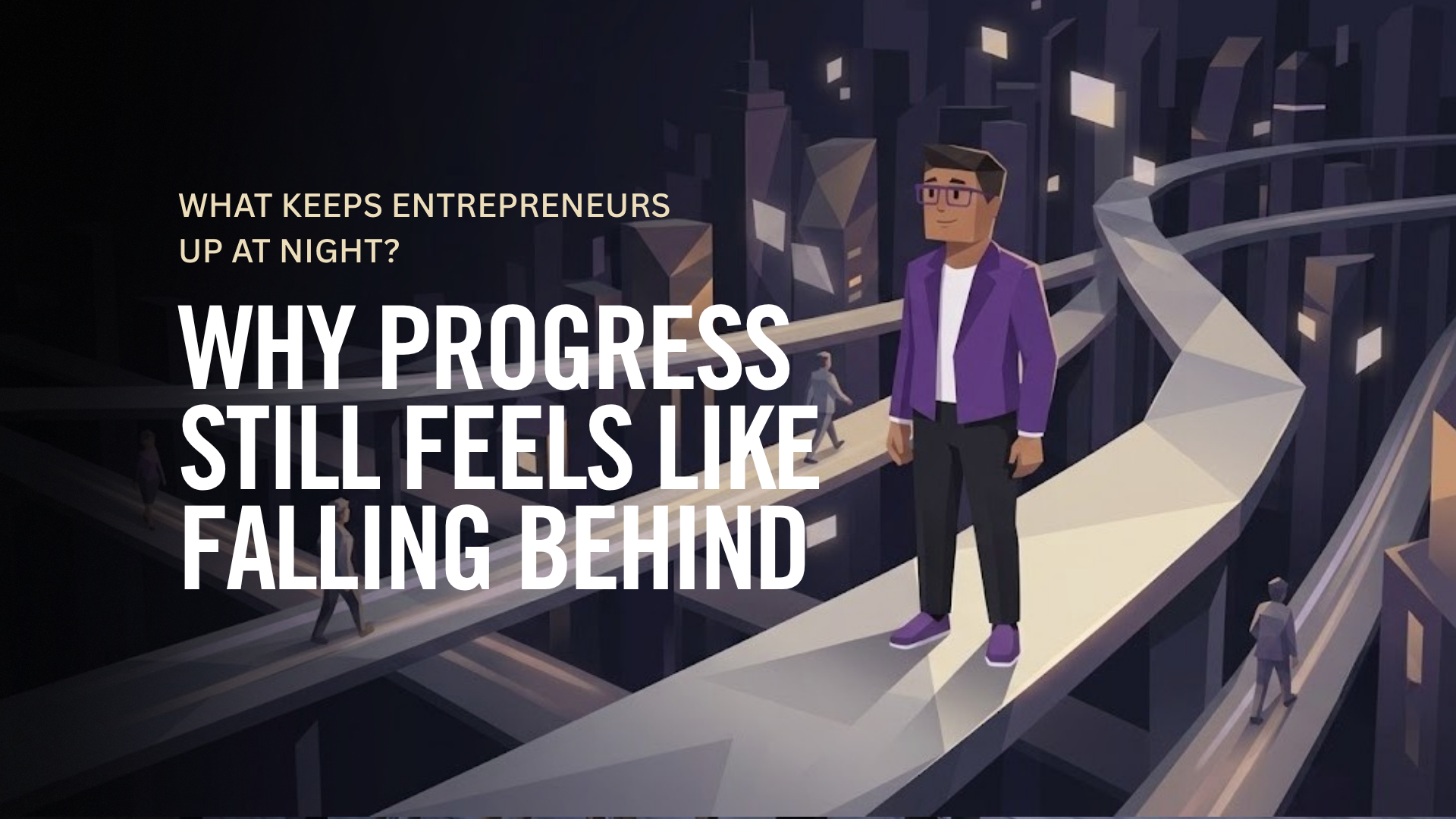
This is the moving finish line of entrepreneurship. The destination keeps moving before the progress has time to register.
It does not always come from envy. Often, it comes from care. Entrepreneurs want to use their time well. They want the risks they took to mean something. They feel responsible for the people who believe in the business and for the potential they can see but have not yet reached. Seeing someone else move faster can turn that care into a quiet fear that they are wasting time.
The outside world rarely sees that part. It sees the announcement, the launch or the new office. It does not see the question sitting behind the achievement: Should I be further by now?
That question can make meaningful progress difficult to recognize. It can also change the way entrepreneurs remember their own journey. The difficult seasons become evidence of delay rather than proof of endurance. The steady work that strengthened the business feels less impressive than the visible leap someone else just made.
At BTI, I have seen how easily business conversations become centred on what comes next. That forward focus is part of entrepreneurship, and it can create energy. It can also leave very little room to acknowledge what has already changed. The person leading the business may be so close to the unfinished work that they cannot see what others now experience as growth.
There is a human need beneath all of this. We want evidence that the effort is leading somewhere. We want to know that the sacrifices were not misplaced and that the business is becoming what we hoped it could be. When those answers feel uncertain, comparison offers a quick measurement, even when it is not a fair one.
A slower path can still be a meaningful path. Quiet progress does not become less real because it is harder to announce. Some of the most important changes in a business happen before they are visible from the outside. Trust deepens. Judgment improves. The team becomes more capable. The entrepreneur begins making decisions with greater clarity.
Those changes may not create a dramatic post, but they change what the business can hold. They make future growth possible in ways that are difficult to photograph or announce.
I do not think entrepreneurs need to stop caring about growth or become indifferent to what others are building. The tension is more personal than that. It is about noticing when someone else's pace has become the standard used to judge your own life.
There may always be another milestone ahead. Ambition has a way of creating one. The question is whether the next milestone has made the progress behind you impossible to feel.
Whose pace have you quietly turned into a deadline for your own life?