What Are You Still Trying to Prove?
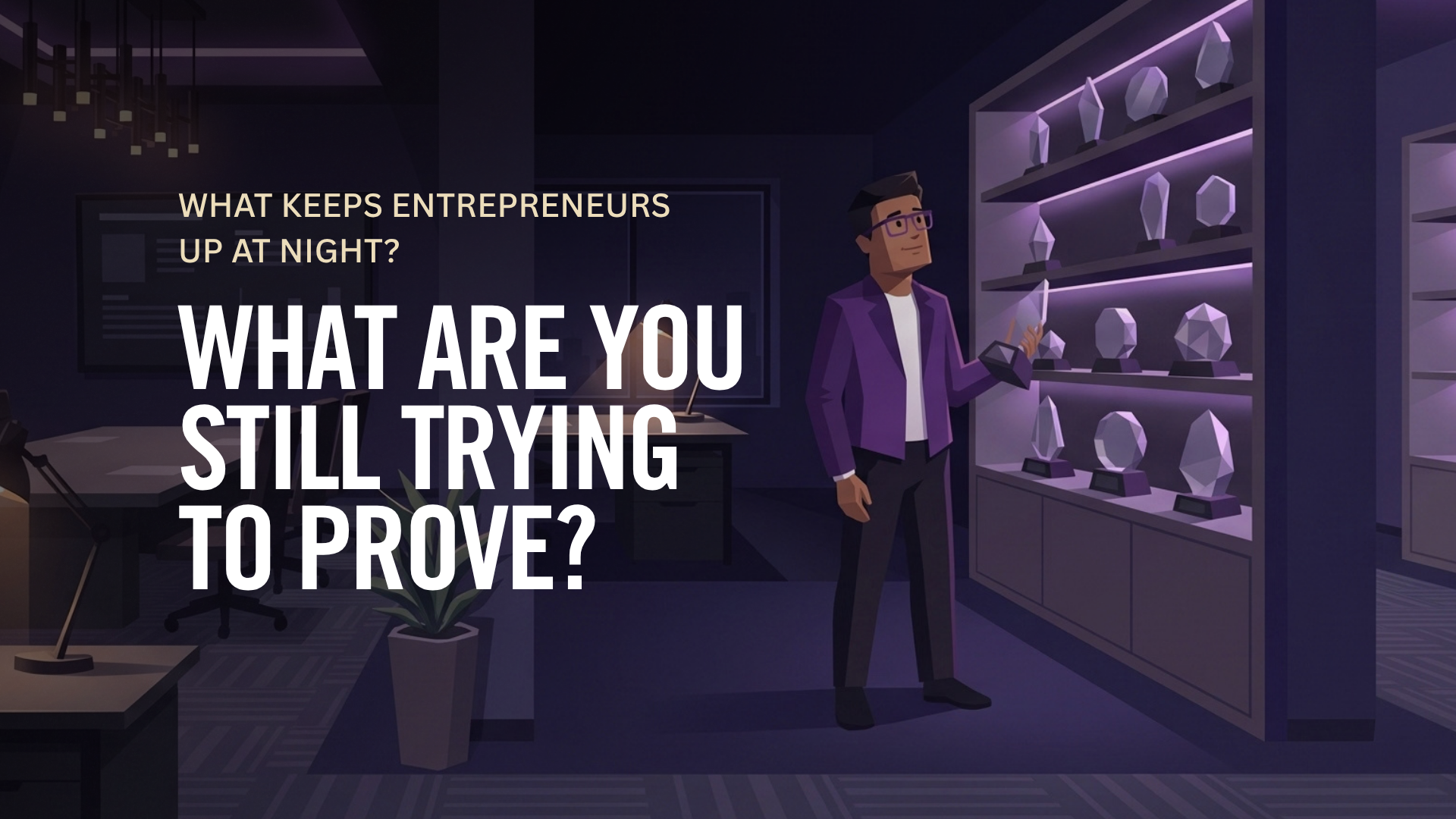
What Are You Still Trying to Prove?
Ambition has been part of my life for as long as I can remember. I like building things. I like the challenge of seeing whether an idea can become real, and I still get energy from creating something that did not exist before.
Lately, I have been wondering about a different part of ambition: the part that may continue long after we have already proved what we once set out to prove.
For many entrepreneurs, the early years carry some kind of internal test. Can I build a business? Can I make this work? Can I create something people value? The answers are never guaranteed, so every milestone carries a little more evidence that maybe we are capable of doing this after all.
Eventually, though, the evidence accumulates.
The business survives difficult years. People trust you with responsibility. You build relationships and make decisions that once felt beyond your experience. At some point, the original question of whether you can do it has already been answered many times.
What interests me is that the need to prove it does not necessarily disappear at the same moment.
I do not look back at that earlier drive as a problem. The need to prove something can carry us through years when there is very little external evidence that the effort will work. It can help us keep going through rejection and uncertainty. The question changes only after the proof is already there, and the same drive keeps asking for another demonstration.
I can see how easily ambition becomes self-renewing. One achievement creates the conditions for another. A larger opportunity appears, and pursuing it feels natural because forward movement has been part of the story for so long. There is nothing wrong with that. Wanting more can be genuine.
But I have started asking myself whether every new goal is still connected to something I want now, or whether some goals are carrying an old assignment.
Maybe the assignment was to prove that I could build something meaningful. Maybe it was to demonstrate that an idea could work when others were uncertain. Whatever the original source, success can answer the question without automatically releasing us from it.
That possibility feels important at this stage of my life because the cost of another ambition is different than it was when I was younger. Time feels more visible. A new commitment has to live beside relationships, community and the parts of life I do not want to keep postponing.
The question is not whether ambition is good or bad. I would not want to remove it from who I am. It has created experiences, relationships and opportunities that have shaped my life.
I am more curious about whether ambition can change once proof is no longer required.
What would I build if the outcome did not need to say anything about my capability? What would I pursue if nobody was keeping score? Those questions feel different from asking what I can do next because they remove some of the audience, including the audience in my own head.
There is freedom in that possibility, but also uncertainty. Proving something gives ambition a clear target. Meaning is less tidy. It asks whether the work itself, and the life around it, are enough reason to say yes.
I suspect this is one of the transitions many experienced entrepreneurs eventually face. We become capable of doing more things at the same time that we become more aware that capability is not a reason to do all of them.
For me, the work now is not to become less ambitious. It is to understand what ambition is for when it no longer needs to prove that I belong in the room.
Sometimes the proof arrives before the need to prove disappears. Recognizing that does not erase the drive. It may simply give us a chance to decide what we want the drive to serve next.
If you no longer needed to prove that you could succeed, what would you still choose to build?